
Designing for Agency
Sustaining Human Engagement Across Changing Conditions

Beyond drift and diagnosis
In the first post of this short series, I defined “agency drift”. Then the second post explored the idea of an agency audit.
This final post shifts from diagnosis to design by asking a different question: What helps sustain agency over time?
The question is no longer simply how agency drifts, but how our lives, environments, and technologies can be shaped to preserve meaningful participation as conditions change.
Agency is about engagement, not independence
Discussions about aging often frame success in terms of independence: whether a person can still perform tasks on their own without assistance. But agency is not identical to independence.
A person may rely on tools, support systems, or other people while still participating meaningfully in shaping decisions, interpreting situations, adapting to change, and directing the course of daily life. Sustained human engagement across changing conditions is more important than total self-sufficiency.
Designing one’s own life
Agency may not be a fixed trait so much as a pattern of participation that can strengthen or weaken depending on how we live.
Agency in later life is more likely to be preserved if it has been practiced and exercised with intentionality throughout life. We’re used to thinking about cognitive and physical capabilities as things that need to be exercised in order to preserve them. We don’t necessarily think about agency in the same manner but perhaps we should. And while change (both changes in internal capacities and external environments) is inevitable, we can learn to prepare for such changes and learn to be more adaptable.
Part of this may involve mindset, but it also involves habits and routines that shape how we continue interacting with the world over time.
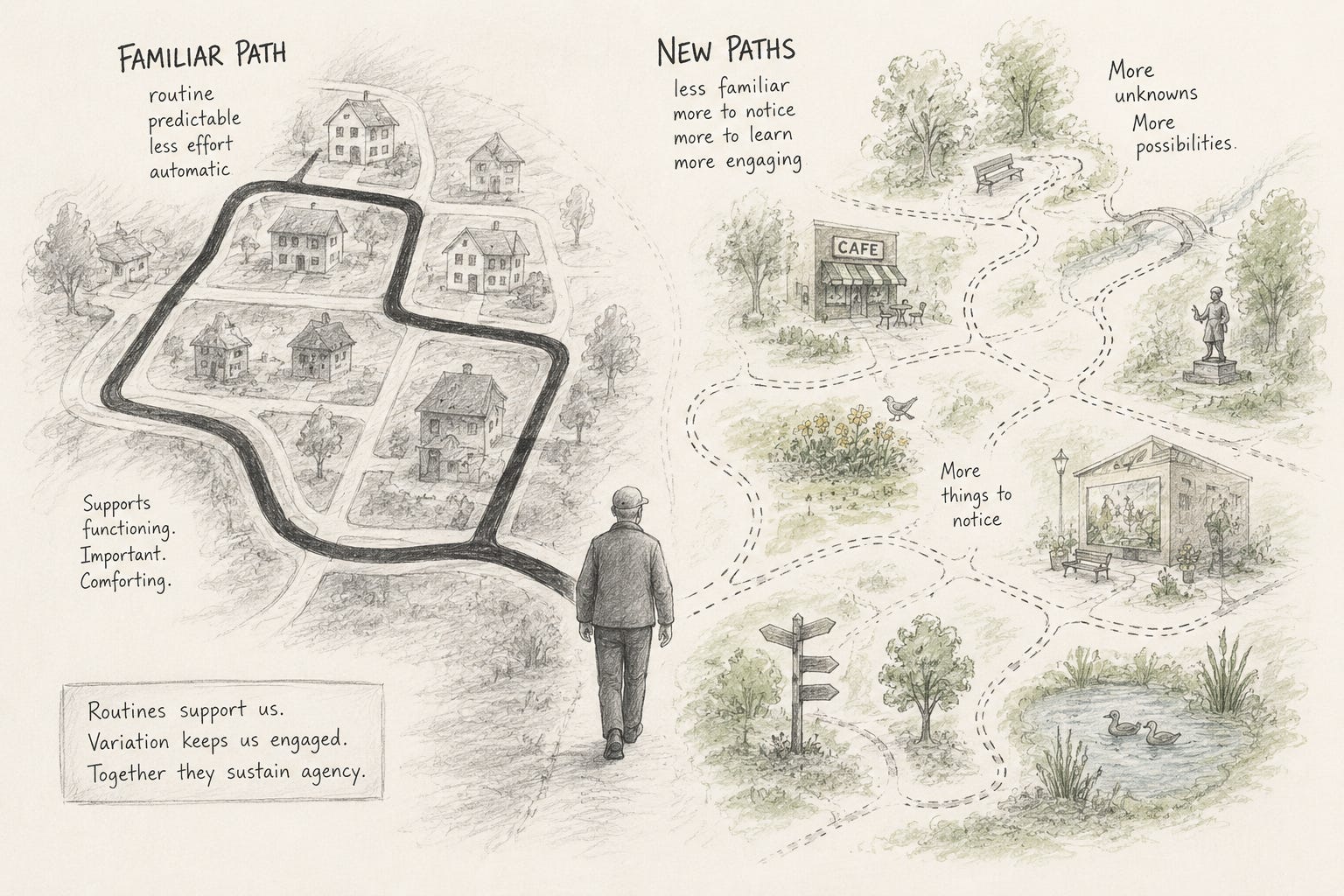
I have a familiar walking route that I use regularly. At the same time, I intentionally take a completely different route through the neighborhood every week or so. The familiar route reduces effort and supports routine. The unfamiliar route requires a more active form of attention. I notice more. I orient myself differently. I engage with the environment more actively rather than moving through it automatically.
At different stages of life, the appropriate challenge changes. At one point, adaptive engagement may involve navigating unfamiliar countries or learning entirely new systems. Later, it may involve smaller but still meaningful forms of exploration, adjustment, and participation.
The design of systems and environments
If agency is something we practice individually, it is also something shaped collectively. Agency is never purely individual. Environments participate in shaping what remains possible.
Examples include opaque healthcare portals, AI systems that auto-complete decisions, navigation systems that reduce orientation skills, recommendation systems that narrow exploration, and care systems that prioritize efficiency over participation.
There is a significant difference between systems that support and systems that substitute for human engagement.
Well-designed systems extend participation. Poorly designed systems may preserve outcomes while quietly reducing understanding, initiative, or involvement.
Friction: the unexpected design principle
Modern systems are often designed to remove friction wherever possible. In many situations, that is beneficial. Harmful friction can lead to confusion or frustration. But complete frictionlessness may also reduce opportunities for orientation, learning, decision-making, and adaptation.
Not all friction is harmful. Some forms of manageable friction help preserve engagement with the world. Productive friction can slow us down just enough to support reflection, learning, orientation, and active participation in decision-making.
The point is not to maximize difficulty. It is to preserve enough challenge, variation, and participation to keep us actively involved in shaping our own lives.
Agency as ongoing adaptation
None of us know exactly how we will change, or how the world around us will change with us. Over time, it becomes easier for decisions, directions, and interpretations to be handled elsewhere by systems, by routines, by other people.
Designing for agency means preserving enough involvement that we continue to notice, orient ourselves, adapt, and take part in shaping how things unfold, rather than having them shaped entirely for us.